Intermediate assembly 19
Intermediate exercise 19: Shaft in pillow blocks assembly
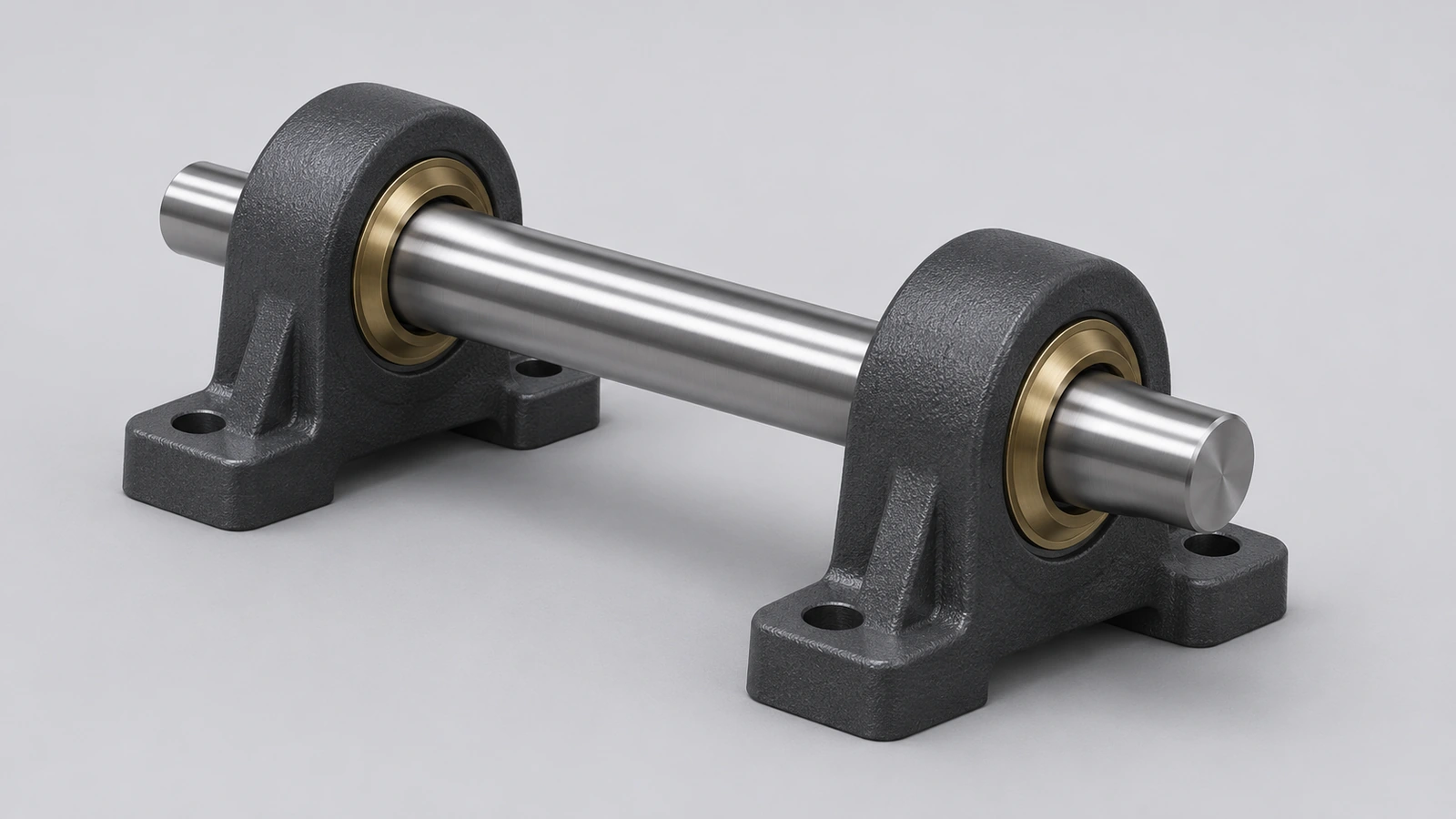
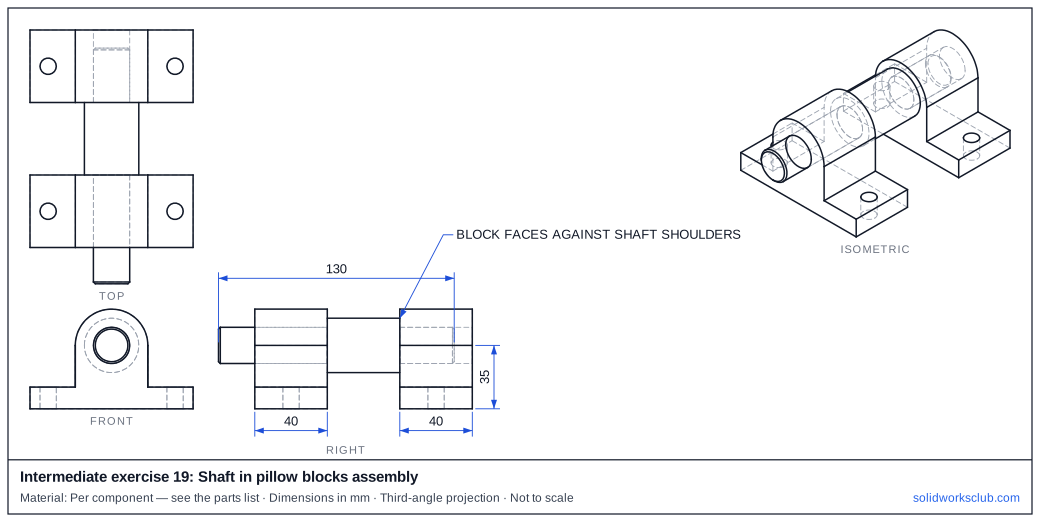
The stepped shaft from basic exercise 3 carried by two cast-iron pillow blocks from this set. Each block's inner face sits against a shoulder of the shaft — a typical way to locate a shaft axially.
 Kevin Walsh
- Level
- Intermediate
- Time
- 20 min
- Material
- Per component (see parts list)
- Check mass
- 1,754.40 g total
The drawing
Parts list
| Part | Qty | Material | Exercise |
|---|---|---|---|
| Pillow block | 2 | Grey cast iron | model it |
| Stepped shaft | 1 | Mild carbon steel | model it |
What you practise
- Concentric mates between a shaft and bores
- Locating parts against shoulders
- Centre of mass along an axis
How to approach it
- Insert pillow block 1 fixed. Insert block 2 with its bottom face coplanar with block 1's and its bore concentric with block 1's bore.
- Insert the shaft: concentric with both bores.
- Mate block 1's inner face to the shoulder at the end of the 60 mm Ø20 section; block 2's inner face to the other shoulder.
- The short Ø20 end ends 10 mm inside block 2.
Check your result
Give every part the material from the parts list, then open Evaluate → Mass Properties in the assembly. The total mass should be 1,754.40 g. The centre of mass lies in the vertical plane through the shaft axis, 77.26 mm along the shaft from its long Ø20 end and 23.36 mm above the blocks' bottom faces. Mass Properties reports the centre of mass in the assembly's coordinate system; with the first part's origin at the base and its bottom face on the Top plane, the height above the base is the Y value. The CSWA asks the same kind of question — see the practice test.
Next: all exercises.
Download files
Commands used
Show solution
- Insert pillow-block (fixed). Insert a second block: Coincident bottom faces, Concentric bores.
- Insert stepped-shaft: Concentric with both bores.
- Coincident: block 1 inner face to the shoulder 60 mm from the shaft's long end; block 2 inner face to the shoulder at 100 mm.
- Mass = 2 × 655.48 + 443.43 = 1,754.40 g.
Frequently asked questions
Why is the centre of mass below the shaft axis?
+
The heavy cast-iron blocks sit mostly below the 35 mm bore axis, so the combined centre of mass is lower.
Related
- SOLIDWORKS practice exercisesFree SOLIDWORKS practice exercises: dimensioned drawings, STEP files and a check mass for every part, from first plates and shafts to bigger parts.
- Intermediate exercise 18: Bracket pair assemblyIntermediate SOLIDWORKS exercise 18, bracket pair assembly: coincident and flush mates. Drawing, STEP file and check mass 741.28 g.
- SOLIDWORKS standard matesHow to use SOLIDWORKS standard mates: coincident, parallel, perpendicular, tangent, concentric, lock, distance and angle, Quick Mates and lock rotation.
- Free CSWA practice testFree CSWA-style practice test with a 45-minute timer — knowledge questions plus five modelling problems with drawings, scored with worked answers.