Intermediate exercise 6
Intermediate exercise 6: Compression spring
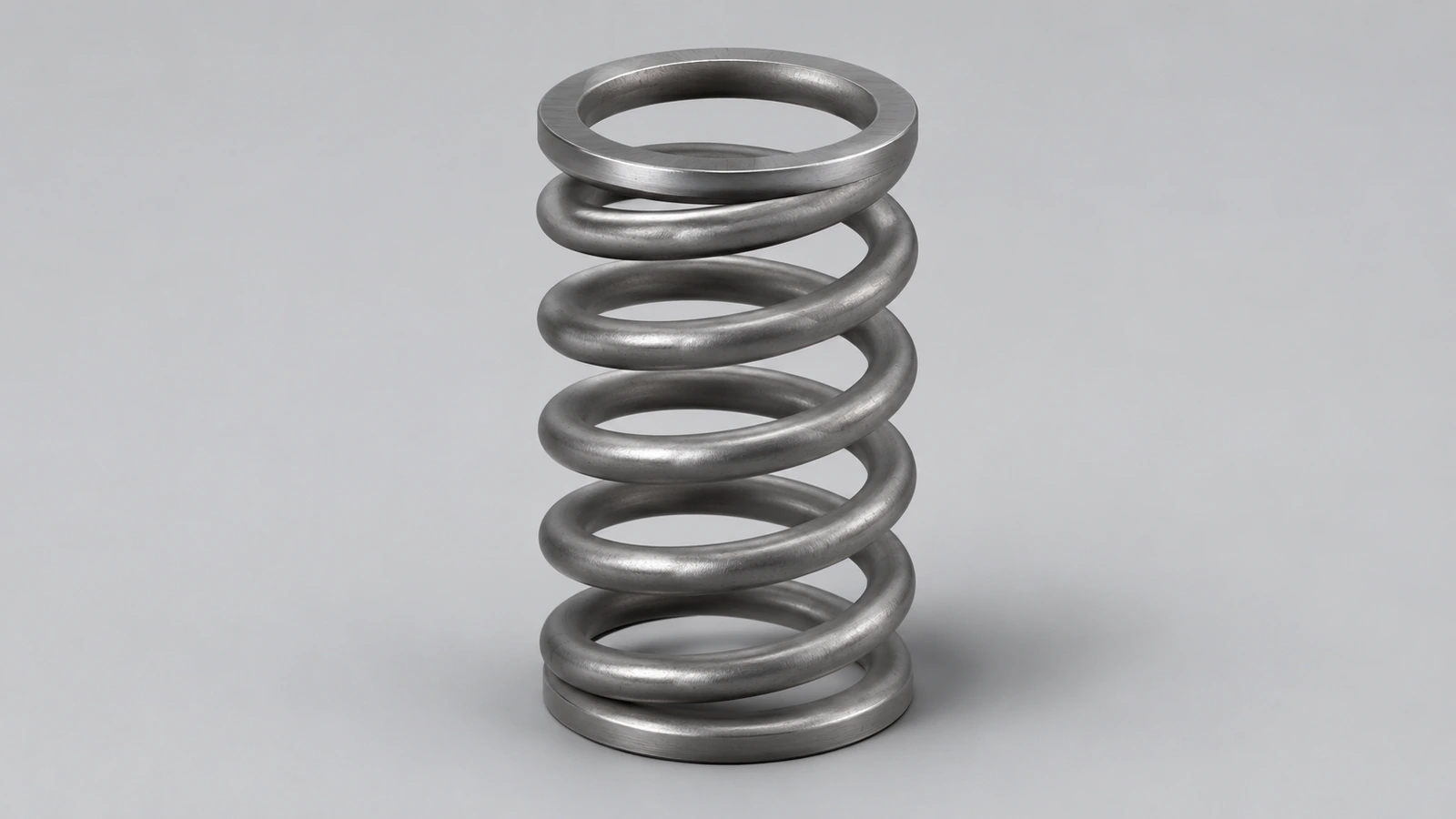
A steel compression spring: a Ø3 wire swept along a helix of six turns. It teaches Helix/Spiral and a sweep along a 3D curve.
 Kevin Walsh
- Level
- Intermediate
- Time
- 15 min
- Material
- Mild carbon steel, 7.85 g/cm³
- Check mass
- 31.38 g
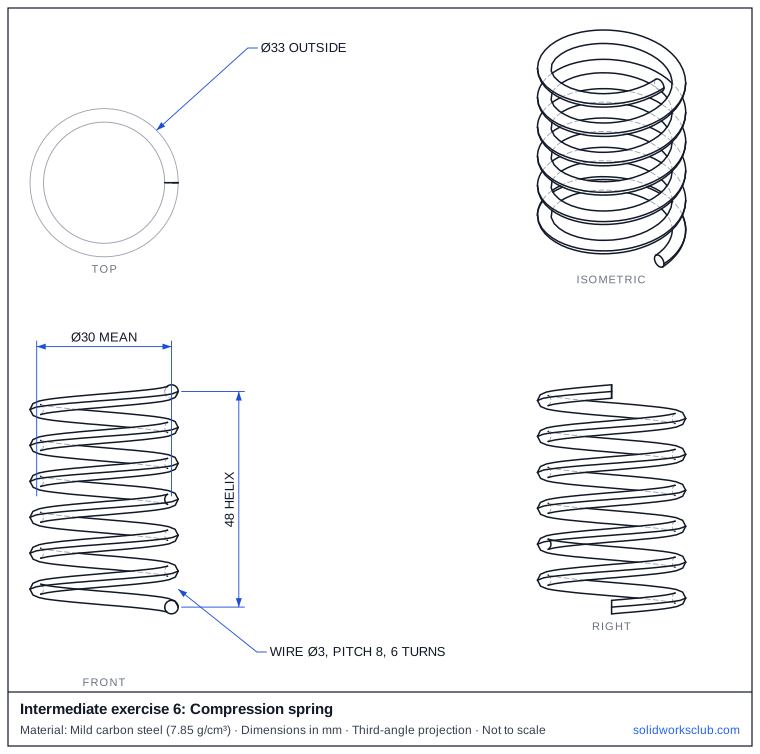
The drawing
What you practise
- Helix/Spiral curve from a circle
- Sweep profile on a plane through the axis
- Sweeping along a 3D curve
How to approach it
- Top plane: Ø30 circle, then the Helix/Spiral curve: height 48, pitch 8 (6 turns), start angle 0.
- Front plane (through the axis): Ø3 circle centred on the helix start point (pierce relation).
- Sweep the circle along the helix.
Check your result
Apply Mild carbon steel or a custom material with 7.85 g/cm³, then open Evaluate → Mass Properties. The mass should be 31.38 g (volume 3,997.19 mm³). Off by 1,000? Check the density units with the mass calculator.
Next: intermediate exercise 7.
Download files
Commands used
Show solution
- Ø30 sketch → Helix: Height and Pitch, 48 / 8.
- Front plane: Ø3 circle with a Pierce relation to the helix.
- Swept Boss, profile = circle, path = helix.
- The profile sits on a plane through the axis, so the volume is π × 1.5² × helix length × cos(helix angle) ≈ 3,997.2 mm³.
Frequently asked questions
Why is the volume not exactly area × length?
+
The profile lies on a plane through the axis, not perpendicular to the wire, so the swept cross-section is slightly smaller than a true Ø3 circle.
Related
- Intermediate exercise 7: Swept handleIntermediate SOLIDWORKS exercise 7, swept handle: open path sketch with tangent arcs. Drawing, STEP file and check mass 112.86 g.
- Intermediate exercise 5: Enclosure with screw bossesIntermediate SOLIDWORKS exercise 5, enclosure with screw bosses: fillet before Shell. Drawing, STEP file and check mass 166.92 g.
- SOLIDWORKS SweepHow to use Swept Boss/Base and Swept Cut in SOLIDWORKS: profile and path rules, Pierce, circular profiles, orientation, twist and guide curves.
- Mass calculator for SOLIDWORKS and CSWA problemsCalculate part mass from volume and density in mm, cm, m or inches, with typical densities for steel, aluminium, brass and copper. Built for CSWA checks.