Certification
CSWA sample questions by section
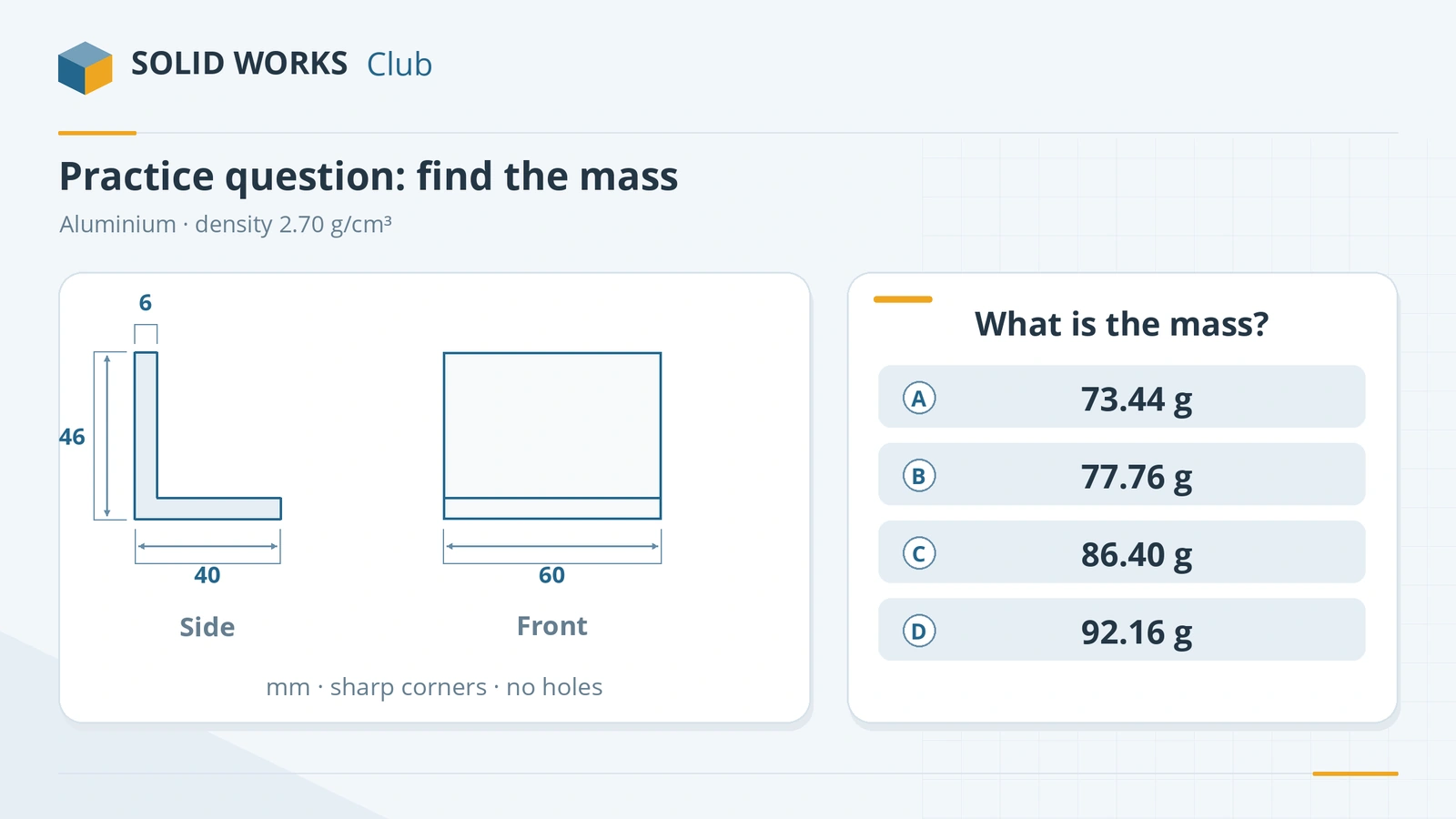
CSWA questions fall into five sections: drafting competencies (which view or tool to use), basic, intermediate and advanced part modelling, and assembly modelling. Apart from drafting, almost every question gives you a drawing and asks for a mass, a centre of mass or a measurement after you build or change the model. Below are original examples of each type and how to approach them.
 Kevin Walsh
1. Drafting competencies
Short knowledge questions about drawings. Original examples:
- Which view would you create to show the true shape of a face on an inclined plane? → An auxiliary view.
- To show a hidden internal groove, the engineer cuts the part along a line across the front view. Which view is that? → A section view.
- Which view enlarges a small chamfer so it can be dimensioned? → A detail view.
Know these drawing views and what they are for: standard 3 views, projected, auxiliary, section, aligned section, detail, broken-out section, break and crop. The terms are defined in our glossary.
2. Basic part creation and modification
You get a drawing of a simple part, its material and density. Example: Build a 120 × 80 × 10 mm aluminium plate (0.0027 g/mm³) with four Ø10 through holes 15 mm from each edge. What is its mass? → about 250.72 g. A follow-up might change a dimension ("increase the thickness to 12 mm") and ask for the new mass.
Approach: set units to MMGS, build the base feature from the largest profile, add the holes, apply the material, read Evaluate → Mass Properties.
3. Intermediate part creation and modification
More features and some design intent — patterns, ribs, shells, fillets, revolves. Example: A brass stepped shaft has diameters 40, 25 and 15 mm with lengths 30, 50 and 20 mm (0.0085 g/mm³). What is its mass? → about 559.11 g.
Approach: revolve one sketch rather than stacking extrusions; it is faster to modify when the follow-up question changes a diameter.
4. Advanced part creation and modification
Complex parts with angled faces, cut-outs on several planes, and sometimes a question about the centre of mass relative to a given point. Expect to create reference planes and a coordinate system.
Approach: read the whole drawing first, decide which view defines the base profile, and fully define sketches so later changes behave predictably.
5. Assembly creation and modification
You download parts, assemble them with mates in a given position, and report the assembly's centre of mass or a distance or angle. Questions often say which coordinate system to use.
Approach: check every part's material before you start, use concentric and coincident mates as instructed, create the coordinate system the question describes and use Mass Properties with that coordinate system selected. A wrong origin is the commonest mistake (official exam lessons).
Practise
- Our free, timed CSWA practice test has twelve knowledge questions and five modelling problems with drawings.
- The official CSWA sample exam shows the real format.
- Check masses with the mass calculator.
Format, price and rules are in the CSWA guide.
Brush up the sketch skills the exam relies on in our sketching course.
Frequently asked questions
Where can I find official CSWA sample questions?
+
SOLIDWORKS publishes an official CSWA sample exam as a ZIP download, linked from the official CSWA page. It includes models and questions in the real format.
Are the CSWA questions multiple choice?
+
Partly. The first question in a section is typically multiple choice; follow-up questions that modify the design usually ask you to type a number, such as a mass in grams with two decimals.
What is the hardest part of the CSWA?
+
For most people, the assembly section: it is worth half the points in the academic layout and needs correct mates, a correct coordinate system and the right materials in several parts at once.
Related
- Free CSWA practice testFree CSWA-style practice test with a 45-minute timer — knowledge questions plus five modelling problems with drawings, scored with worked answers.
- CSWA exam guide: format, cost and how to prepareThe CSWA (SOLIDWORKS Design Associate) exam in 2026 — $99, 3 hours, 70% to pass, online with your own SOLIDWORKS. Sections, rules and a study plan.
- Mass calculator for SOLIDWORKS and CSWA problemsCalculate part mass from volume and density in mm, cm, m or inches, with typical densities for steel, aluminium, brass and copper. Built for CSWA checks.
- SOLIDWORKS glossaryPlain-English definitions of SOLIDWORKS terms — FeatureManager, PropertyManager, mates, configurations, fully defined, K-factor, SpeedPak, Pack and Go.